Give Now

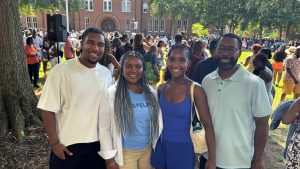
The Simms family will all participate in HBCU homecoming festivities next month. Pictured left to right: Hunter Simms (sophomore at North Carolina A&T Honors College), Kaliq Simms (Morgan State University class of ’96), Hope Simms (freshman at Spelman College), and Joseph Simms (Morgan State University class of ’92).

HBCUs: Normalizing Black Excellence, Preserving History, and Strengthening Baltimore 

For generations, Historically Black Colleges and Universities (HBCUs) have served as engines of opportunity, leadership, and economic mobility for Black Americans. Their impact is especially visible in Maryland, home to institutions such as Morgan State University, one of the nation’s leading public HBCUs. Although HBCUs represent just 3% of U.S. colleges and universities, they produce 40% of Black engineers, 50% of Black lawyers, 50% of Black doctors, and 80% of Black judges.1  

For many fundholders at the Baltimore Community Foundation (BCF), those statistics reflect lived experience. Interviews with several BCF fundholders reveal common themes: gratitude, opportunity, community, economic mobility and a commitment to ensuring future generations succeed. Beyond supporting their alma maters, they are also investing in organizations that help Black college students overcome barriers and thrive during and after college. 

For Kaliq and Joe Simms, HBCUs are woven into their family’s story. Both are graduates of Morgan State University, and their commitment to HBCUs spans generations. Today, their daughter attends Spelman College and their son attends North Carolina A&T State University. They describe their HBCU experience as transformative, providing not only an education but also professional opportunities, lifelong relationships, and financial stability. 

“We support HBCUs because HBCUs supported us,” shared Kaliq. “Our philanthropy is rooted in gratitude, responsibility, and legacy.” The Simms’ commitment goes beyond donated dollars; Joe serves as the Board President for the Morgan State University Foundation. 

The Simms view their giving as an investment in future generations. Their support helps strengthen scholarships, academic programs, and institutional growth so future generations can benefit from the same environment that helped shape their own success. 

That sense of gratitude is also evident in the experience of Paul Clary. Paul credits Morgan State University with helping shape his entrepreneurial journey. He recalls professors who invested in students and a campus culture that fostered ambition and achievement. “My experience at Morgan was incredibly formative, both personally and professionally,” he said.  

Paul and Alecia Clary support HBCUs because of what they are doing today to advance African Americans.

Paul and his wife Alecia support HBCUs through organizations such as the Student Freedom Initiative, which addresses the wealth gap between Black and White Americans by increasing access to HBCUs. Paul explained that the initiative’s pay-it-forward lending model helps current students while creating opportunities for future generations. 

“There are a lot of organizations that support HBCUs,” he explained. “What really intrigued us about Student Freedom Initiative is that they provide continuous solutions and support for students.”  

For the Clarys, HBCUs remain essential, “The history and tradition are great, but we support HBCUs because of what they are doing today to advance African Americans,” they shared.  

Clary’s business partner, entrepreneur and philanthropist Phil Croskey, shares a similar perspective. Originally from Cleveland, he came to Baltimore to attend Morgan State University and built a successful career in Maryland. He credits Morgan with helping him develop the confidence and perspective that continue to shape his leadership.  

“At Morgan State, I saw Black excellence as normal,” Croskey said. “There was an expectation that you could and would succeed.”  

Phil and Jallon Croskey at the Williams-Franklin Foundation fundraiser they hosted at their home this summer.

Today, Croskey supports students through the Williams-Franklin Foundation, which helps HBCU students facing financial obstacles that might otherwise force them to leave school. He believes philanthropy should help remove barriers while expanding opportunity. There are so many students whose dreams have been deferred because they owe three thousand dollars…I’ve been privileged to have some success in business, and I have figured out that my purpose for being here is to be a blessing for others,” he said.  

BCF fundholders Scott Shane and Francie Weeks did not attend HBCUs but have donated to the Thurgood Marshall College Fund and UNCF (United Negro College Fund) for years. Per Scott, “After we moved to Baltimore in 1983, I came to appreciate Morgan, perhaps especially their incredible choir and the talent and pride it represents, and Coppin, which has been a door to higher education for generations of folks who might not otherwise have one. So Francie and I are happy to do our small part to support HBCUs.” 

Across all conversations, one message stood out: HBCUs are not only preserving Black history, they are actively creating it. Fundholders described these institutions as places where Black achievement, scholarship, leadership, and culture are celebrated and sustained. The Simms family called HBCUs “living archives of Black intellectual life” while also noting that every graduating class creates a new chapter in that history.  

Croskey echoed that sentiment, describing HBCUs as enduring institutions that have served Black Americans since the aftermath of slavery. “The story is still being told,” he said. “They are creating history by creating Black excellence and success.”  

For Maryland’s Black community, the impact of HBCUs extends far beyond campus boundaries. These institutions educate leaders, create pathways to economic mobility, cultivate community, and preserve cultural legacy. For BCF fundholders, supporting HBCUs is more than charitable giving. It is an investment in people, in opportunity, and in the future of Black communities.

1 UNCF, Thurgood Marshall College Fund and Partnership for Education Advancement Announce Historic Collaboration to Improve Socioeconomic Outcomes for Black Communities – UNCF 

A New Look

[insert page='a-new-look' display='content']

Please Download

[wpdm_package id='19503']
[wpdm_package id='19509']

Would you like printed copies?

Contact John Gilpin at jgilpin@bcf.org to request hard copies of our Personal Estate Planning Kit. Please provide your mailing address and how many copies you would like.

Want even more free resources?

Visit our planned giving website to find additional tools and resources to help your clients.

Building Stronger Neighborhoods Regionwide

We have a nearly 30-year history of offering grants to resident-led groups and community projects in Baltimore City and Baltimore County. These grants give residents the resources they need to accomplish a small project, get more people involved, and encourage the next generation of neighborhood leaders. We also fund programs that support the development of leaders of all ages who are working to improve their neighborhoods and schools. Our support is intended to help identify, activate, inform and network leaders. And finally, we believe when schools and neighborhoods team up to improve their school and community, meaningful and lasting change can be made. We are interested in funding proposals in which the students and adults in schools collaborate intentionally with community residents, neighborhood associations, and other individuals, groups, and institutions in the area surrounding a school.  

School Leadership

We believe that attracting and retaining effective and diverse school leaders is a key lever for change in Baltimore’s educational landscape, and so we fund school leadership development efforts at the district and individual school level. We are interested in funding proposals that focus on principal coaching, mentoring, peer networking, wellness/self-care, as well as pipelines that identify and develop new leaders. We will also continue to support efforts that build a culture of appreciation and encouragement for school leaders.

How Can We Help?

Melissa McC. Warlow
Director, Baker Fund Grants Program
410-332-4172 x150

Apply for a Grant

Our on-line application system provides applicants with a portal to start a new grant application or to continue updating an application already in process. Please be sure to select the “Save and Finish Later” button when you are finished working on your application in order to save your current session’s work. At any time during the application process you can select the “Contact Us” button in the top right corner of the screen and you will be able to send an email to the Baltimore Community Foundation staff with specific questions. 

To be considered for funding, proposals must be submitted through the online application portal, however, we provide a PDF version of the application along with other useful forms here for your reference:   

When you are ready please select one of the following options:

OPTION 1

I have not applied for BCF funding online in the past.
Select this option if you have never used our website to apply for a grant from BCF.

OPTION 2

I previously applied for BCF funding online in the past.
Select this option if you have applied for any of BCF’s grants using our website. Your profile may still be in our system and you may login using your account.

Place-based Grantmaking in Selected School Communities

We have allocated funds for two geographical areas that bookend a crucial corridor on the Westside of Baltimore City: Howard Park /Forest Park area (served by Calvin Rodwell Elementary Middle School and Liberty Elementary), and Reservoir Hill/Penn North area (served by Dorothy I Height Elementary). In these three schools and their surrounding neighborhoods, we will support projects and activities designed to make the communities safe, clean, green and vibrant; and improve the quality of the schools. Some projects may be neighborhood-focused, some school-focused and others collaborative projects between the schools and their respective communities.

Early Learning & Judy Centers

High quality early childhood education has a lifelong effect on students. Through our Early Learning grant program, we are interested in system-wide early childhood education proposals that will help Baltimore City and County’s youngest learners, and their families, get the start they need. Nonprofit organizations that offer programs and/or services to Judy Centers are encouraged to contact the centers directly to explore partnership opportunities.

How Can We Help?

John A. Gilpin

J.D., CAP®,AEP®

Director of Planned Gifts
410-332-4171 ext. 132

How Can We Help?

Kate Sam

Communications Officer
410-332-4171 ext. 181

How Can We Help?

Cathy Brill

Executive Director
Leonard and Helen R. Stulman Charitable Foundation

Request BCF Documents

Please fill out this form and select the documents you are requesting.