Give Now

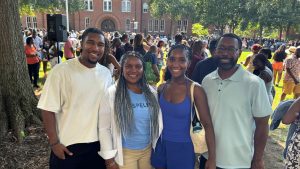
Lead designer and builder volunteers Morgan Singer, Shamy Garcia and Sara Rowan along with other volunteers and staff cut the ribbon on the new teacher's lounge at Mary Ann Winterling Elementary School.

Educator Support Collaborative Brings Welcome Spaces to Teachers

Cristina Easton, a former Baltimore City Schools teacher and principal, can still remember the teacher’s lounge at one of her schools. “It was in an old Home Ec classroom that, for some reason, had a bathtub in it where we went and had lunch every day,” she recalls. “But nobody wanted to be in there, and what that meant was that over time, we ended up eating lunch alone in our classrooms. So we didn’t talk to each other about our struggles. We didn’t talk to each other about ideas. We didn’t get out of the classroom all day long.”

Today, Easton is the executive director of Educator Support Collaborative (ESC), which received startup funding from BCF fundholders and more recently a Stronger Schools Climate & Culture grant from BCF to create “educator wellness lounges” for hard working teachers and school staff. ESC was born out of COVID-19 when teachers were burned out from online teaching and crisis management, though the need for educator support predated the pandemic. A well-designed teacher lounge can significantly enhance school culture and climate by fostering collaboration, reducing burnout, and building a sense of community. When it’s a welcoming space that encourages rest, peer connection, and informal dialogue, it helps teachers feel valued and supported.

Before and after of the teacher’s lounge transformation at Mary Ann Winterling Elementary School

Easton explains that many schools do not have a teacher’s lounge—nowhere for educators to put their belongings during the day, to eat lunch or chat with peers in private and away from students—or the lounge is in an extra room that’s an afterthought. “Help for our educators often gets framed in resources and opportunities for students, and that’s absolutely critical,” says Easton. “But who is looking out for the adults? We know that strong teachers make strong schools, and strong schools make strong communities. So creating a space in a school just for the educators can have a meaningful impact on morale and culture.”

ESC spaces are designed with input from faculty at each school and brought to life largely by donations and the volunteerism of design, construction, and engineering professionals. (ESC has leveraged approximately $500,000 worth of pro bono goods and services in the execution of its mission.) One school may want a place for quiet, another for physical wellness. All lounges are havens for adult professionals that provide opportunities for organic mentorship, idea sharing…or simply a place to eat lunch in peace.

Before and after of the teacher’s lounge transformation at Mary Ann Winterling Elementary School

Kamala Carnes is the principal at Augusta Fells Savage Institute of Visual Arts, one of the first schools to receive an ESC lounge. Carnes describes the former school lounge as dark and dreary, consisting of mismatched tables with limited seating. Teachers lacked a dedicated workspace to print or organize assignments, and the appliances were outdated. ESC held sessions with school staff to discuss ideas and identified priorities and then met with an architect to communicate those needs and wants, which included an area for staff to relax and connect with colleagues, with dedicated spaces for collaboration, quiet work, and meals.

The new space has created that warm welcome the school desired. “The space features comfortable couches that create a family-style seating area, with plants placed along the windowsills to add a warm, homey touch,” says Carnes. “It includes a spacious work area with new appliances and a designated dining section. Beautiful artwork by Baltimore-based artists is displayed on the walls, adding a local and inspiring aesthetic to the environment.”

Carnes adds that while the new lounge meets all the school’s practical needs, “More than just functional, it’s a healing environment—designed to support wellness, restore energy, and foster a sense of community.”

Volunteer designers and builders celebrate a new lounge with the educators who will enjoy it.

To date, ESC has worked with ten schools, impacting 489 educators working with 3,589 students and plans to complete at least 20 more school projects by 2027. “When we transform drab spaces to create beautiful and comfortable teacher’s lounges, we are directly addressing some of the factors causing a nationwide exodus from the teaching profession,” Easton explains.

Easton shared that ESC knows there is more to be done, “The lounges are only the beginning. We use these projects to build relationships between schools and our talented volunteer design teams, which gives us insight into other ways we can show educators they are valued beyond the lounge.”

A New Look

[insert page='a-new-look' display='content']

Please Download

[wpdm_package id='19503']
[wpdm_package id='19509']

Would you like printed copies?

Contact John Gilpin at jgilpin@bcf.org to request hard copies of our Personal Estate Planning Kit. Please provide your mailing address and how many copies you would like.

Want even more free resources?

Visit our planned giving website to find additional tools and resources to help your clients.

Building Stronger Neighborhoods Regionwide

We have a nearly 30-year history of offering grants to resident-led groups and community projects in Baltimore City and Baltimore County. These grants give residents the resources they need to accomplish a small project, get more people involved, and encourage the next generation of neighborhood leaders. We also fund programs that support the development of leaders of all ages who are working to improve their neighborhoods and schools. Our support is intended to help identify, activate, inform and network leaders. And finally, we believe when schools and neighborhoods team up to improve their school and community, meaningful and lasting change can be made. We are interested in funding proposals in which the students and adults in schools collaborate intentionally with community residents, neighborhood associations, and other individuals, groups, and institutions in the area surrounding a school.  

School Leadership

We believe that attracting and retaining effective and diverse school leaders is a key lever for change in Baltimore’s educational landscape, and so we fund school leadership development efforts at the district and individual school level. We are interested in funding proposals that focus on principal coaching, mentoring, peer networking, wellness/self-care, as well as pipelines that identify and develop new leaders. We will also continue to support efforts that build a culture of appreciation and encouragement for school leaders.

How Can We Help?

Melissa McC. Warlow
Director, Baker Fund Grants Program
410-332-4172 x150

Apply for a Grant

Our on-line application system provides applicants with a portal to start a new grant application or to continue updating an application already in process. Please be sure to select the “Save and Finish Later” button when you are finished working on your application in order to save your current session’s work. At any time during the application process you can select the “Contact Us” button in the top right corner of the screen and you will be able to send an email to the Baltimore Community Foundation staff with specific questions. 

To be considered for funding, proposals must be submitted through the online application portal, however, we provide a PDF version of the application along with other useful forms here for your reference:   

When you are ready please select one of the following options:

OPTION 1

I have not applied for BCF funding online in the past.
Select this option if you have never used our website to apply for a grant from BCF.

OPTION 2

I previously applied for BCF funding online in the past.
Select this option if you have applied for any of BCF’s grants using our website. Your profile may still be in our system and you may login using your account.

Place-based Grantmaking in Selected School Communities

We have allocated funds for two geographical areas that bookend a crucial corridor on the Westside of Baltimore City: Howard Park /Forest Park area (served by Calvin Rodwell Elementary Middle School and Liberty Elementary), and Reservoir Hill/Penn North area (served by Dorothy I Height Elementary). In these three schools and their surrounding neighborhoods, we will support projects and activities designed to make the communities safe, clean, green and vibrant; and improve the quality of the schools. Some projects may be neighborhood-focused, some school-focused and others collaborative projects between the schools and their respective communities.

Early Learning & Judy Centers

High quality early childhood education has a lifelong effect on students. Through our Early Learning grant program, we are interested in system-wide early childhood education proposals that will help Baltimore City and County’s youngest learners, and their families, get the start they need. Nonprofit organizations that offer programs and/or services to Judy Centers are encouraged to contact the centers directly to explore partnership opportunities.

How Can We Help?

John A. Gilpin

J.D., CAP®,AEP®

Director of Planned Gifts
410-332-4171 ext. 132

How Can We Help?

Kate Sam

Communications Officer
410-332-4171 ext. 181

How Can We Help?

Cathy Brill

Executive Director
Leonard and Helen R. Stulman Charitable Foundation

Request BCF Documents

Please fill out this form and select the documents you are requesting.