As the modern-day Allans, Igleharts, and Howards began reconnecting, they felt the need to better understand the racist systems their family had fought against and that, given the then-recent killings of George Floyd, Breonna Taylor, and Ahmaud Arbery, were clearly still impacting Black Americans. With Zoom now a regular part of life, they began meeting for a monthly book club, discussing books like Wilmington’s Lie by David Zucchino, about the overthrow of a racially integrated government in 1890s Wilmington, North Carolina, and Not in My Neighborhood by Antero Pietila, about the legacy of real estate redlining in Baltimore. The small group included Joan, her brother David Allan and daughter Anne Aleshire (children and granddaughter, respectively, of Angelica and Warde), Hallie Austen Iglehart and Jaime Iglehart (daughter and granddaughter, respectively, of Ike and Harriet), cousin Steve Howard (who is a BCF fundholder with partner Monty Howard), and Steve’s aunt Lucy Howard.
“Over the months, I got the sense that people were interested in doing something more proactive,” says Hallie, an author and teacher. So one day after attending a lecture about an urban farm in Oregon, Hallie went to her family with a thought. The group had been examining the legacy of racial disparities created by real estate redlining and forced displacement of people of color. What if they focused their energies on supporting the growing number of urban farms in Black communities in Baltimore? Their support could help to right past wrongs, spotlighting the value of historically undervalued land, while increasing food sovereignty and food security in communities that had been historically shut out of decision-making processes and suffered consequences ranging from a lack of intergenerational wealth to serious health disparities. “It wasn’t about guilt or changing the past,” says Hallie. “We just felt that we are here now and we should do what we can to bring things into balance.” Joan agrees. “We can’t change the past, but we can change the present and the future—and that’s what we decided to do.”
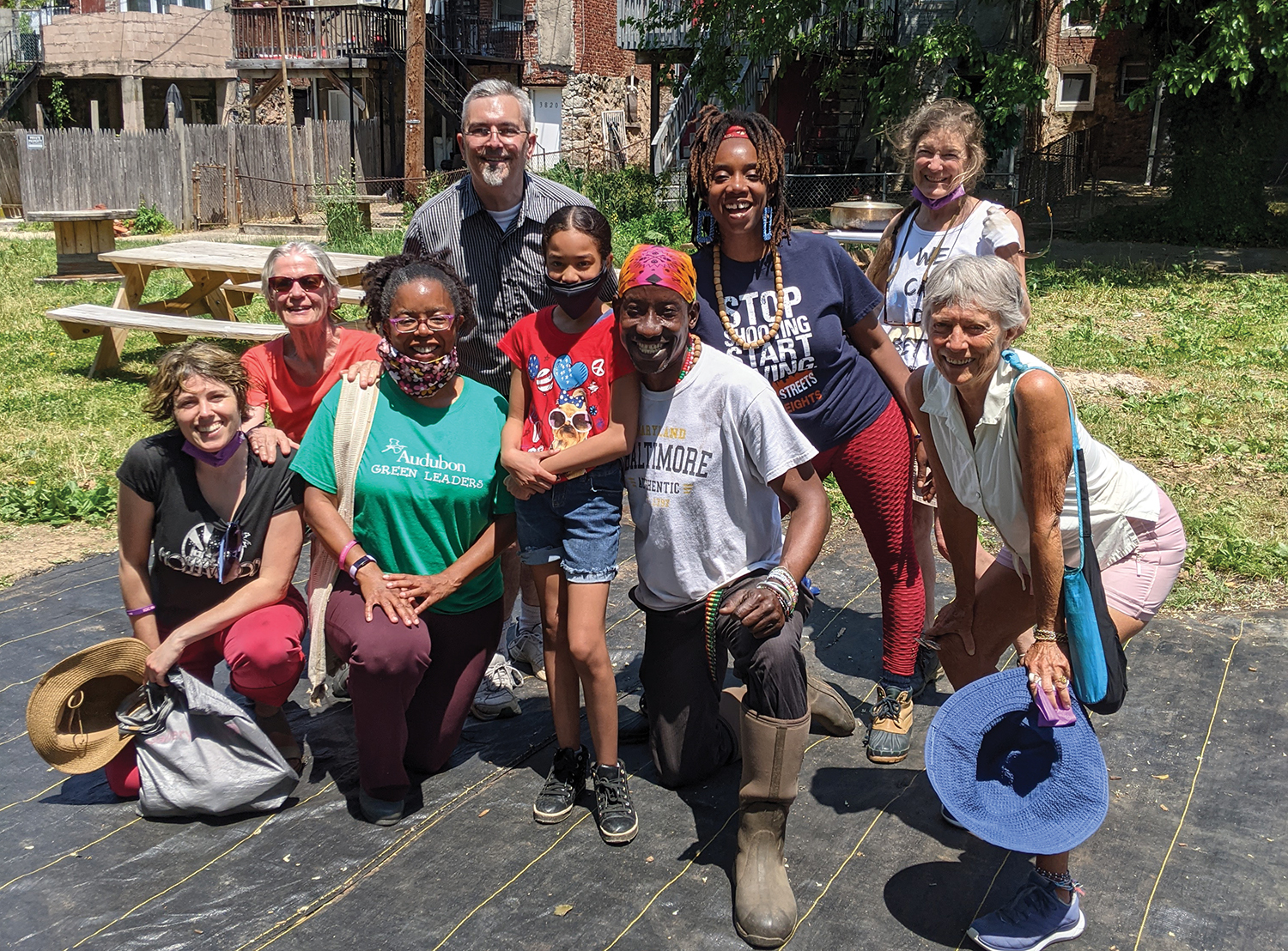
With encouragement from other family members, Hallie reached out to family friend and farmer Kathy Tipper to organize a tour of urban farms, which only increased the family’s enthusiasm. “[The farms] were clearly a haven for crucial quality of life elements, from food security to education, to a safe space for mental health,” says Jaime Iglehart, an artist, filmmaker, and professor. Hallie adds, “We were all struck by the creative energy and vision, in terms of what they’re doing concretely with very little resources.” For example, one farm, Plantation Park Heights, was providing fresh produce to hundreds of families each week and training young people in urban agriculture, but volunteers were spending nearly an hour every night watering plants by hand. “We saw so much potential and that it would take very little to fully unlock that potential,” says Hallie.
The family then called BCF to explore grantmaking opportunities. “With three funds already administered by BCF, we felt confident that we were being guided by people who knew the city and its needs,” says Joan. “BCF is very connected, in a way that we aren’t,” agrees Jaime. “It would take years to know how to make the best impact if we were working alone.” With the family’s existing funds already committed to specific purposes, the group agreed to establish and contribute to a new one: the Urban Farm Fund. By early December, the fund had awarded $28,500 to four organizations spaced geographically across the city: Backyard Basecamp, Baltimore Free Farm, Whitelock Community Farm, and Plantation Park Heights.

Beyond helping to advance social justice, says Steve, a partner at True Chesapeake Oyster Company, the journey to creating the Urban Farm Fund had a crucial added benefit: bringing generations of family together for a greater good. “What we’re doing isn’t necessarily the most time-efficient, but it can be a model for bringing people together from various generations for philanthropy.” There was some trepidation, says Jaime, one of the youngest family members involved at age 39, because “our extended family had not had conversations like this. But at every turn, I’ve been surprised and happy to find how open and ready people were to engage. There’s an illusion broadly that we can’t talk to each other about certain subjects, but it seems harder than it really is in practice.”
Older generations were likewise cautious, but pleasantly surprised, says Hallie. “It’s been an unexpected gift, getting to know and respect my extended family members and I really hope our story might inspire other families to talk about difficult subjects. My advice to older generations who want to engage younger people is to bring whatever you’re passionate about and see if it resonates. It’s a way of seeing what their interests are and an invitation, creating as much space as possible to make choices.” David, a retired teacher and lacrosse coach, has been thrilled by the results. “As a younger person, it was always told to me that we needed to be mindful of those who were not as fortunate as we. I’m happy we can pay that value forward.”

Happily, Harriet Iglehart lived to see these younger generations, spanning in age from 39 to 83, embark on the Urban Farm Fund. She passed away in July 2021 just after the group took its tour and shared pictures with her. “This is something that she would be really proud to support,” says Jaime, who notes that her grandmother saw charitable giving not only as a way to support good causes, but also to educate herself. “I comfort myself that [my mother and father] are living on through this work,” says Hallie. “I want to honor and bow to my elders’ courage. They were great models for a balanced life.”