Setting the Stage
BCF’s support for the region’s artistic endeavors and organizations is painted in broad brushstrokes across five decades. BCF founder Bob Levi and his wife and philanthropic partner Ryda were passionate cultural patrons and directed several BCF leadership grants to the arts. Early BCF board members like Joseph Meyerhoff, founding donor of The Joseph Meyerhoff Symphony Hall, provided critical funding for the city’s creative community. Music patron Clementine Peterson was the first female BCF board member and the first donor to create a BCF fund benefitting an arts organization, the Baltimore Choral Arts Society.
BCF has also been a vocal advocate for the arts over the years, convening and mobilizing others to preserve our region’s rich cultural legacy. In early 1991, concerned that arts funding was dwindling and traditional audiences were aging, BCF created the Arts and Culture Initiative and commissioned a report to document the power of cultural institutions to create community. Noted educator Ernest L. Boyer, Ph. D., worked with an advisory committee of BCF board members, arts administrators and trustees to assess the region’s state of arts and cultural life. While citing diminished public and private funding, the 42-page report concluded that the performing and visual arts “are no longer just desirable, they are essential if we are to relate authentically to each other.” This inspired BCF to pledge $1 million to fund arts-related grants and youth arts education.
A few years later, widely respected civic leaders Edward K. “Eddie” Dunn Jr., BCF board chair, and Calvin “Buddy” Zamoiski Jr., vice chair, brokered a deal to keep the Lucas Collection in Baltimore. The trove of 19th century French prints, paintings and sculptures amassed by Baltimore-born art dealer George Lucas (1824–1909) was bequeathed to Henry Walters with the understanding that it would eventually go to the Maryland Institute College of Art (MICA). By the 1980s, a furor had erupted over the future of the collection as MICA planned to sell it, while the Walters and BMA saw it as a vital piece of Baltimore’s artistic landscape. By 1995, a contentious legal battle had broken out among the organizations. It was Dunn and Zamoiski who negotiated an egalitarian plan for MICA to “sell the Lucas Collection to the [BMA and Walters] to be held in trust for the citizens of Maryland in perpetuity.” BCF provided seed funding to support the sale, ensuring generations of Baltimoreans had access to masterpieces from Mary Cassatt, Eugène Delacroix, Édouard Manet and many others.
Expanding the Scene
In 2010, when BCF honed its strategic grantmaking from nine focus areas to two—strengthening schools and neighborhoods—funding for the arts remained an important component. Under the new plan, BCF grants brought more arts programming into Baltimore City schools and created tangible connections to art through creative placemaking. For example, BCF made a $20,000 grant to Jubilee Baltimore in 2006 to support revitalization efforts in the city’s first designated Arts & Entertainment District, Station North. BCF was also an early funder of the Creative Alliance’s renovation of the Patterson Theater into a multipurpose visual and performing arts space, anchoring the city’s second designated Arts & Entertainment District, Highlandtown. In the years since, BCF has given more than $100,000 to support Creative Alliance operations and programming, including the Great Halloween Lantern Parade and Festival, the Sidewalk Serenades series and The Artesanas, a group of Latin American women who host performances and workshops to share their artistic traditions.
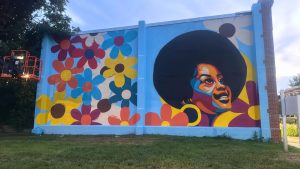
Most recently, BCF funded the Black Arts District’s efforts to revitalize historic Pennsylvania Avenue—long a center of Black arts and culture—and supported the transformation of the Ambassador Theatre in Liberty Heights into a multipurpose arts and culture venue. One of the most vibrant, visible examples of BCF’s sustained support for the arts is a mural at Casa de la Cultura, the Latino cultural center and headquarters of Nuestra’s Raices in Highlandtown that opened in mid-August. Bright hues, painted birds, butterflies and a proud “We Are Baltimore,” cover the once-vacant rowhome, now an anchor for Baltimore’s Latino community.
The Next Act
An important tool as BCF continues to support arts and cultural programming in Baltimore is the Developing Arts Fund (DART), created in 1985 after a successful National Endowment for the Arts challenge match the year before. The nearly $500,000 raised enabled BCF to increase operating support for numerous organizations and endow DART for the “presentation and/or production of visual and performing arts” by modestly budgeted visual and performing arts organizations serving a diverse audience. In 2022 BCF awarded four $10,000 general operating grants from DART to Afro House, Asian Pasifika Arts Collective, Beyond Video and the Black Femme Supremacy Film Fest. See sidebar for more details.

Finally, BCF reaffirmed its commitment to the arts in 2022 with the Baltimore Community Foundation Gallery, located in our first street-level headquarters at 11 E. Mount Royal Avenue. The inaugural exhibit, aptly named Community, examines the vital role that diverse contributions, relationships and connections play in creating far-reaching change and impact. Developed in partnership with the Greater Baltimore Cultural Alliance (GBCA) and Maryland Art Place (MAP), the exhibition, on display until 2024, features 10 artists of diverse racial and ethnic backgrounds, experiences and cultures working in different media.
BCF’s advocacy, strategic grantmaking and service to arts-focused fundholders, are ensuring Baltimore remains a vibrant center for arts and culture—fostering joy, learning, connection and growth for generations to come.